LC UPC Duplex Attenuated Fiber Loopback Module, OS2, 3dB
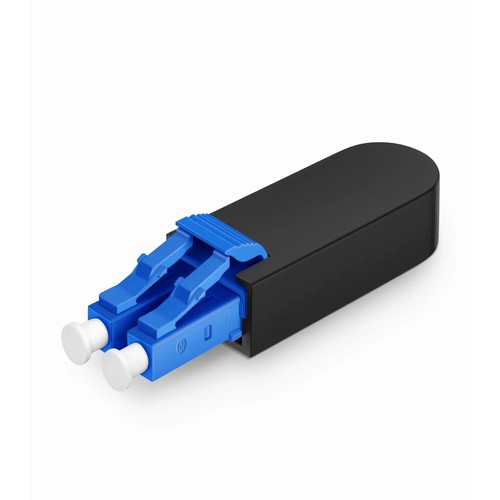
Projects in the Philippines benefit from keeping the configuration, branch identification and installation requirement consistent across every participating site. This fiber loopback module gives a self-contained optical optical route that returns the transmit signal directly into the receive optical path of the port under test: 2F, OS2, in a LC design. A fixed 3dB attenuator sits inside the loop; as a result, the transceiver sees a realistic power budget rather than a zero-loss short circuit - the difference between a port that only lights up and a port that is proven against real loss conditions.
Product Highlights
- Low Insertion Loss ≤0.3dB, High Return Loss ≥50dB
- Ideal for Port Provisioning, Testing, and Troubleshooting
- Compact LC Single Mode Design for Fiber Testing
- Integrated 3dB Attenuation for Direct Tx/Rx Loopback
- Easy Insertion and Extraction with Push-Pull Design
Specifications
| Fiber Type | OS2 9/125μm |
|---|---|
| Fiber Connector | LC/UPC |
| Attenuation | 3dB |
| Attenuation Tolerance | ±0.5dB |
| Insertion Loss | ≤0.3dB |
| Return Loss | ≥50dB |
| Housing Material | PC |
| Mating Cycles | 500 times |
| Dimensions (HxWxD) | 14.4x12x51mm |
| Operating Temperature | -40 to 75°C (-40 to 167°F) |
| Storage Temperature | -40 to 75°C (-40 to 167°F) |
What loopback testing actually proves
A loopback module closes the optical circuit inside one device: the transmitter launches light, the optical module returns it, and the receiver must lock onto its own signal. When the optical path comes up clean under those conditions, the port has proven its transmitter power, its receiver sensitivity and its internal signal integrity in one step. It is the fastest way to separate a bad port from a bad cable plant, given that the fiber cable plant is entirely removed from the test.
Why an attenuated loopback tells more
A zero-loss loopback proves the optics operation; it is not intended to prove they operation at the optical budget the real optical path will impose. The fixed 3dB attenuator inside this optical module simulates the connector interface pairs and fiber span of a real optical path; as a result, the receiver must work at a realistic power level. Ports with marginal receiver sensitivity - the ones that fail three months after implementation - are caught at the bench instead of in the field.
Using 3dB in a test plan
Three decibels approximates the loss of a short haul with a couple of mated connector pairs: a realistic operating point for single-mode links. When the test plan calls for margins, engineers step through power levels with a variable attenuator; when it calls for a fast, predictable pass/fail at a realistic budget, a fixed 3dB loopback is the one-push tool that stays in the kit.
Looping duplex transceiver ports
Duplex LC and SC ports - SFP, SFP+ and equivalent form factors - are tested one port at a time. The loopback seats into the cage like a patch cord and stays latched for the duration of the test, leaving both hands free for the console. Because the optical module is a single solid body, there is no cord to kink and no polarity to arrange: transmit returns to receive by design.
Keeping single-mode test hardware clean
Single-mode testing is unforgiving about contamination: a dust particle on the ferrule adds loss that masquerades as a failing receiver. Keep the dust cap on the optical module whenever it should not be treated as mated, review the ferrule before insertion, and clean with a proper ferrule cleaner rather than improvised materials. A loopback that lives in a pocket without its cap will eventually fail good ports.
Handling, wear and service life
A loopback module is a precision test tool, and it stays one only while its latch, housing and ferrule survive daily duty. The insert-pull rating is generous, but it should not be treated as infinite: track the mating count in the test log, and retire a module that has served a production line for years before its wear becomes the hidden cause of failing ports. A worn latch that seats loosely adds loss that masquerades as a bad receiver - the cheapest instrument in the kit may waste the most expensive hours.
A bench test workflow that scales
The productive way to use loopbacks is a fixed routine: review the optical module ferrule, mate it with the port, bring the interface up, record the per-lane status and the receive power, then unmate and cap the optical module immediately. With the routine fixed, a technician qualifies a full chassis of ports in the time an improvised setup spends on one line card. The consistency additionally makes the records comparable - the equivalent module, the equivalent practice, the equivalent pass criteria across every site and every batch of hardware.
Sparing and kit planning
Loopbacks belong in every commissioning kit the way a known-good patch cord does. Plan one module per interface type per crew, plus a spare that stays sealed in its bag; the cost of an extra module is trivial against a truck roll to re-test a suspect port. Label each module with its interface, fiber count and attenuation so the right one comes out of the bag on the first try, and log its insertion count so a worn test tool never becomes the hidden cause of failing ports. Project teams in the Philippines can carry this requirement into the site documentation used by each contractor.
Selecting the right loopback for the task
Four decisions define the optical module: the connector interface interface must align with the port under test, the fiber count must cover the lanes the optics use, the mapping type must pair the lanes the way the transceiver expects, and the attenuation must reflect the optical budget the test plan calls for. Getting all four right at order time is what turns a loopback from a drawer of adapters into a dependable instrument. When the need sits outside the standard configurations, the factory may validate a custom build - connector combinations, mapping variants and other attenuation values are all manufacturable options.
Production Testing and Quality Assurance
Every loopback module is optically tested before packing: insertion loss of the complete loop is verified against the specification, and the ferrule end faces are inspected for scratches and contamination. The optical module ships with its dust cap fitted and the test result provided on order.
Placing an Order and Factory Support
Refer to this optical module by connector interface, fiber count, polish and attenuation when submitting a request for a quotation. For other attenuation values, mapping types or connector combinations, send the test need with the inquiry and the factory will validate the manufacturable specification. Customers in the Philippines can include multi-site labeling or documentation requirements when requesting a project quotation.
Fiber Optic Cables
Fiber Transceivers
Get a quick quote
 Lisa Zhou
 Steve Yan
 Flora Luo
 Stone Wang
 Allen Hu
About us
China Factory:No 168 Golden Ground Industrial Area;Philippines Address:Makati City,Metro Manila, Philippines