LC UPC Duplex OS2 Fiber Keystone Jack, 10pcs/Pack
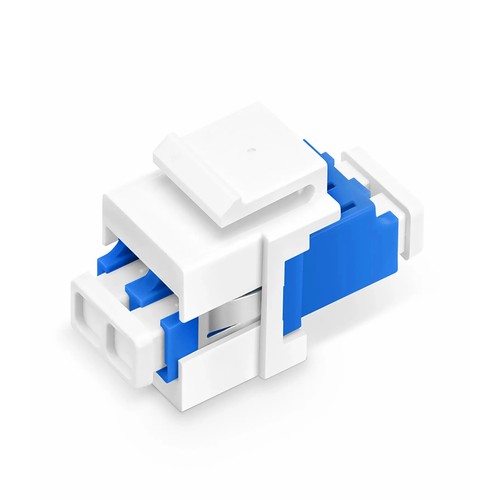
Projects in the Philippines benefit from keeping the configuration, branch identification and installation requirement consistent across every participating site. %s brings fiber to the work-space outlet in the equivalent keystone format used for copper jacks. This coupler snaps into standard keystone faceplates, surface boxes and patch panels; as a result, the fiber drop terminates exactly where the user needs it - at the desk, the cabinet or the consolidation point.
Product Highlights
- Used for Keystone Wall Plates or Panels with Standard-sized Keystone Openings
- One-piece Dust Cap Keeps Adapter’s Interior Clean from Dust
- High-precision Mating Structure with ≤0.2dB (Typical) Low Insertion Loss
- Sturdy Snap-in Construction for Fast and Tool-less Installation
- Color-coded for Rapid Fiber Management
Specifications
| Connector Type | LC-LC |
|---|---|
| Body Style | Duplex |
| Polish Type | UPC |
| Fiber Mode | Single Mode |
| Insertion Loss | ≤0.2dB |
| Durability | 1000 times |
| Mounting Type | Reduced Flanged |
| Color | Blue |
| Flammability Rate | UL 94V-0 |
| RoHS Compliancy Status | Compliant |
| Operating Temperature Range | -25 to 70℃ (-13 to 158℉) |
| Storage Temperature Range | -25 to 70℃ (-13 to 158℉) |
| Compliance Center | Test Center |
Why the alignment sleeve decides adapter quality
Every optical adapter is, at heart, a sleeve alignment problem: two connector ferrules must meet on one axis with their end faces touching, and any eccentricity shows up directly as insertion loss. Given that it machines to sub-micron tolerance, resists wear across repeated matings and holds its dimensions through temperature swings, zirconia ceramic is the standard sleeve material. The adapters in this range use zirconia sleeves rated for insertion loss of 0.2 dB or better, which keeps an adapter pair well inside any power budget.
Fiber at the work-area outlet
The keystone format standardized copper work-space outlets decades ago, and fiber keystone jacks put optical ports in the equivalent faceplates, surface boxes and floor outlets. The jack snaps in from the front, the pigtail or cord terminates behind, and the user sees a clean shuttered port. For fiber-to-the-desk, industrial terminals and consolidation points, the keystone jack turns a fiber drop into an outlet that matches every other outlet on the wall.
Faceplates, boxes and keystone panels
A keystone jack is only as useful as the hardware that holds it. Standard faceplates take one to four jacks; surface-mount boxes serve retrofits where the wall cannot be opened; keystone patch panels load twenty-four jacks into a rack unit for space-efficient termination. Mixing fiber jacks with copper jacks in one faceplate is normal practice - the format is shared; as a result, the outlet plan follows the services, not the other way around.
Shuttered adapters in live environments
An open adapter port is an invitation to dust, and dust on a ferrule end face is the single most common cause of unexplained loss. A shuttered adapter closes an internal flap the moment the connector interface withdraws, keeping the sleeve bore clean until the next mating. The equivalent shutter blocks the direct line of sight into a live port, a small but real safety gain where high-power transmitters are in service. Shuttered versions cost slightly more and repay it the first time a port stays clean through a long design phase.
What adapter testing actually measures
An adapter contributes no signal of its own; as a result, its test is a mating test: reference connectors mate through this coupler, and the inserted loss is recorded. A zirconia-sleeve adapter should add no more than 0.2 dB, and the mating must repeat that figure across cycles. Durability testing runs the mating hundreds of times and re-measures - a sleeve that wears loose announces itself as creeping loss. These figures, not the housing color, are what separates an adapter that serves for years from one that becomes the mystery fault.
Selecting the right adapter for the panel
Five decisions define this coupler order: the connector interface pairing must align with both sides of the mating, the mounting style must fit the fiber panel cutout, the polish color code must align with the plant, the sleeve material must suit the operation grade, and the count must cover the load-out plus spares. Getting all five right at order time is what turns a bag of couplers into a dependable panel. Where the pairing crosses connector families, the hybrid range covers the common conversions.
Production Testing and Quality Assurance
Every adapter is inspected before packing: the sleeve bore is checked for alignment and surface finish, the housing latches are cycled for positive engagement, and sample matings from each production lot are measured for insertion loss. Accessories are checked for fit against the adapters they serve. Project teams in the Philippines can carry this requirement into the site documentation used by each contractor.
Placing an Order and Factory Support
Refer to this adapter by connector pairing, mounting style, polish grade and pack unit count when submitting a request for a quotation. For configurations outside the listed options - mixed packs, panel hardware kits or project packaging - send the need with the inquiry and the factory will validate the manufacturable specification. Customers in the Philippines can include multi-site labeling or documentation requirements when requesting a project quotation.
Fiber Optic Cables
Fiber Transceivers
Get a quick quote
 Lisa Zhou
 Steve Yan
 Flora Luo
 Stone Wang
 Allen Hu
About us
China Factory:No 168 Golden Ground Industrial Area;Philippines Address:Makati City,Metro Manila, Philippines