LC UPC Quad OS2 SC Footprint Fiber Adapter with Flange, 10pcs/Pack
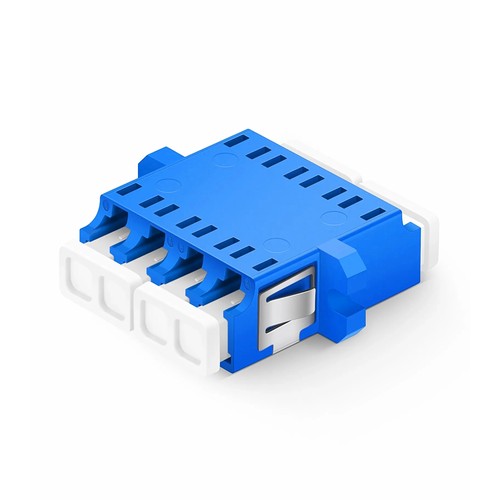
Projects in the Philippines benefit from keeping the configuration, branch identification and installation requirement consistent across every participating site. LC UPC Quad OS2 SC Footprint Fiber Adapter with Flange couples two LC/UPC connectors into one continuous optical optical route. Inside the housing, a zirconia ceramic sleeve holds both ferrules on a common axis, keeping insertion loss low and predictable across hundreds of mating cycles. The flanged housing screws directly to the fiber panel cutout for a permanent, vibration-proof mounting.
Product Highlights
- Stainless Steel Clips for Tool-less Snap-in Installation
- Available in A Variety of Connector Types
- ≤0.2dB(Typical) Low Insertion Loss
- Color Coded for Rapid Fiber Management
- 2x Duplex Dust Cap Keeps Adapter’s Interior Clean from Dust
Specifications
| Connector Type | LC-LC |
|---|---|
| Body Style | Quad |
| Polish Type | UPC |
| Fiber Mode | OS2 9/125μm |
| Insertion Loss | ≤0.2dB |
| Durability | 1000 times |
| Mounting Type | Full Flanged |
| Color | Blue |
| Flammability Rate | UL 94V-0 |
| RoHS Compliancy Status | Compliant |
| Operating Temperature | -40 to 85℃(-40 to 185℉) |
| Storage Temperature | -10 to 60℃(14 to 140℉) |
| Connector Type | LC/UPC |
| Body Style | Quad |
| Fiber Mode | SM OS2 |
| Insertion Loss | ≤0.2dB |
Phosphor bronze and zirconia sleeves compared
Two sleeve materials dominate this coupler market. Zirconia ceramic sleeves give the tightest alignment and are the right alternative for single-mode and high-operation multimode work, where core geometry leaves no room for eccentricity. Phosphor bronze sleeves serve legacy multimode and metallic-ferrule connectors where the tolerance need is looser and the cost matters more. Matching the sleeve to the application keeps both operation and budget under control.
Bulk packs and the economics of sparing
Panel work consumes adapters in dozens, not singles: a frame reload takes a full pack, and the spares kit must hold more against breakage, contamination and this coupler that vanishes during a hurried re-entry. The ten-piece pack format matches that reality - one pack per panel mounting point covers the load-out with spares, and the unit cost drops well below single-piece pricing. Bulk packs additionally guarantee that every adapter on the fiber panel is the equivalent revision, the equivalent color and the equivalent sleeve quality.
Kit planning for panel installation
A disciplined panel deployment kit counts everything before the van leaves: adapters at one pack per panel plus a spare, caps for every unused port, the screws or clips the fiber panel needs, and the cleaning supplies that keep end faces serviceable. Adapters are the cheapest line on that list and the one whose absence stops the job outright. The bulk pack format makes the counting simple - two packs per mounting point and the mounting point is covered, installed and spared.
Panel cutouts and footprint discipline
Adapter panels are standardized around a handful of footprints, and the SC simplex footprint is the most common: duplex LC adapters are built to drop into the equivalent cutout, which is why LC and SC positions interchange freely on modern frames. Keeping to the standard footprint matters when a panel is re-loaded years later - the replacement adapter must fit the hole that is already there.
What adapter testing actually measures
An adapter contributes no signal of its own; as a result, its test is a mating test: reference connectors mate through this coupler, and the inserted loss is recorded. A zirconia-sleeve adapter should add no more than 0.2 dB, and the mating must repeat that figure across cycles. Durability testing runs the mating hundreds of times and re-measures - a sleeve that wears loose announces itself as creeping loss. These figures, not the housing color, are what separates an adapter that serves for years from one that becomes the mystery fault.
Selecting the right adapter for the panel
Five decisions define this coupler order: the connector interface pairing must align with both sides of the mating, the mounting style must fit the fiber panel cutout, the polish color code must align with the plant, the sleeve material must suit the operation grade, and the count must cover the load-out plus spares. Getting all five right at order time is what turns a bag of couplers into a dependable panel. Where the pairing crosses connector families, the hybrid range covers the common conversions.
Production Testing and Quality Assurance
Every adapter is inspected before packing: the sleeve bore is checked for alignment and surface finish, the housing latches are cycled for positive engagement, and sample matings from each production lot are measured for insertion loss. Accessories are checked for fit against the adapters they serve. Project teams in the Philippines can carry this requirement into the site documentation used by each contractor.
Placing an Order and Factory Support
Refer to this adapter by connector pairing, mounting style, polish grade and pack unit count when submitting a request for a quotation. For configurations outside the listed options - mixed packs, panel hardware kits or project packaging - send the need with the inquiry and the factory will validate the manufacturable specification. Customers in the Philippines can include multi-site labeling or documentation requirements when requesting a project quotation.
Fiber Optic Cables
Fiber Transceivers
Get a quick quote
 Lisa Zhou
 Steve Yan
 Flora Luo
 Stone Wang
 Allen Hu
About us
China Factory:No 168 Golden Ground Industrial Area;Philippines Address:Makati City,Metro Manila, Philippines