24 Fibers MTP Female Type 1 Fiber Loopback Module, OM4
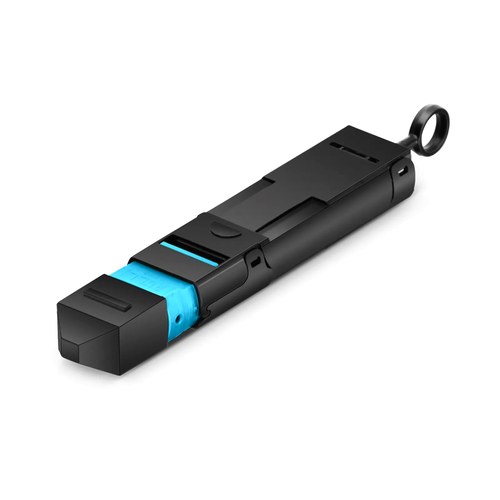
This 24 loopback module provides a compact optical self test for parallel ports. It routes transmit lanes back to the receive lanes inside a rugged housing, so you can verify port function, run burn-in tests and diagnose link faults without a second device.
Product Highlights
- Fiber Type: OM4 50/125μm
- Fiber Connector: MTP® Female, UPC
- Insertion Loss: MM (BIF)≤1.2dB
- Return Loss: MM≥25dB
- Insert-Pull Test: 50times, IL Change<0.5dB
- Factory tested, individually packed
Specifications
| Part Number | LPM-OM4-24MTP |
|---|---|
| Manufacturer | HT |
| Fiber Type | OM4 50/125μm |
| Fiber Connector | MTP® Female, UPC |
| Insertion Loss | MM (BIF)≤1.2dB |
| Return Loss | MM≥25dB |
| Insert-Pull Test | 50times, IL Change<0.5dB |
| Size | 80mm*10mm |
| Operation Temperature | -40 to 75°C (-40 to 167°F) |
| Housing Material | PC |
Applications
Typical uses are switch and NIC port validation in production, burn-in testing before shipment, troubleshooting suspect links in the field, and verifying cabling channels end to end. It lets a single technician confirm that a parallel port transmits and receives correctly on every lane.
Using the Loopback Correctly
Loopback testing isolates faults quickly: if the link comes up with the loopback installed, the port and transceiver are healthy and the problem lies in the cabling or far end. If it does not, the fault is local. This simple test saves hours of guesswork during commissioning.
Ordering Information
To order, quote LPM-OM4-24MTP together with the length and quantity you need. Private labeling, custom packaging and project specific documentation are all handled in-house.
Built to Your Spec
We have manufactured fiber optic assemblies since 1995. MPO and MTP cabling is one of our core lines: fiber counts from 8 to 144, single mode and multimode, UPC and APC polish, trunk, jumper, harness and breakout formats. Send your drawing and we turn it into a ready to install assembly.
Logistics
We dispatch worldwide by international courier, with air and sea freight options for bulk orders. Goods can be sent collect on your courier account, and documentation for customs clearance is provided with every shipment.
Quality and Testing
Every MPO/MTP assembly leaving our factory is 100% tested for insertion loss and return loss, with end face geometry checks on the multi-fiber ferrules. Controlled polishing keeps the loss budget stable across the whole batch, which matters when several mated pairs sit in one link.
Fiber Optic Cables
Fiber Transceivers
Get a quick quote
 Lisa Zhou
 Steve Yan
 Flora Luo
 Stone Wang
 Allen Hu
About us
China Factory:No 168 Golden Ground Industrial Area;Philippines Address:Makati City,Metro Manila, Philippines