H3C QSFP-100G-D-AOC-30M Compatible 100G QSFP28 4 x 25G NRZ Active Optical Cable, 30m (98ft)
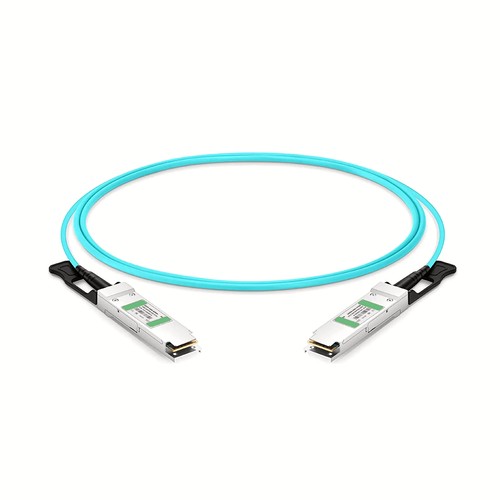
A successful 100G link depends on host acceptance as well as physical fit. This QSFP-100G-D-AOC-30M compatible AOC assembly combines QSFP28 to QSFP28 with a fixed 30m (98ft) cable for H3C equipment. The specifications, configuration guidance and live-link factory verification below describe the exact product supplied under this reference.
OEM Part Number: QSFP-100G-D-AOC-30MHT Part Number: QSFP-100G-D-AOC-30M
Product Highlights
- Compatible alternative to H3C QSFP-100G-D-AOC-30M
- 100G connectivity at 100Gbps
- Interface configuration: QSFP28 to QSFP28
- Fixed length and part number: 30m (98ft), QSFP-100G-D-AOC-30M
- Cable construction: Optical Cable
- Maximum power consumption: <2.2W
- Minimum bend radius: 30mm
- Operating temperature: 0 to 70°C (32 to 158°F)
Specifications
| HT Part Number | QSFP-100G-D-AOC-30M |
|---|---|
| H3C Compatible | QSFP-100G-D-AOC-30M |
| Manufacturer | HT |
| Form Factor | QSFP28 to QSFP28 |
| Max Data Rate | 100Gbps |
| Minimum Bend Radius | 30mm |
| Cable Length | 30m (98.43ft) |
| Jacket Material | OFNP |
| Cable Type | Optical Cable |
| Receiver Type | PIN |
| Transmitter Type | VSCEL |
| Wavelength | 850nm |
| Power Consumption | <2.2W |
| MTBF | ≈50 Million Hours |
| Power supply | 3.3V |
| Commercial Temperature Range | 0 to 70°C (32 to 158°F) |
| Protocols | IEEE 802.3 bm, SFF-8665 |
| CDR (Clock and Data Recovery) | TX & RX Built-in CDR |
| Modulation Format | 4x 25G-NRZ to 4x 25G-NRZ |
| Application | 100G Ethernet |
Signal and Lane Configuration
The listed modulation format is 4x 25G-NRZ to 4x 25G-NRZ. Both host interfaces must be configured for the same aggregate rate and lane arrangement. A connector that fits mechanically does not by itself guarantee that the remote port supports this encoding or breakout mode.
Power and Thermal Planning
The rated power consumption is <2.2W. Include this load in the host-port power and thermal budget, especially in densely populated switches. Maintain front-panel clearance and do not bundle the cable so tightly that it obstructs airflow around the connectors.
Cable Construction and Routing
This assembly uses OFNP jacket, minimum bend radius 30mm. These mechanical characteristics affect how the cable should be dressed behind the equipment. Avoid sharp edges, excessive ties and repeated tight bends close to the connector boots.
Network and Protocol Considerations
The intended application is 100G Ethernet. Listed interface and protocol references include IEEE 802.3 bm, SFF-8665. Confirm that the host firmware and port configuration support the same operating mode.
Integrated Optical Assembly
The optical engines and fiber are permanently integrated into this AOC. There are no detachable optical modules to clean or exchange. Handle the complete assembly by its connector housings and cable, and keep both ends matched to the same interface specification.
Length Selection and Installation Planning
Longer assemblies require disciplined cable dressing. For QSFP-100G-D-AOC-30M at 30m (98ft), use the intended managers rather than a diagonal route across the rack, and leave enough space to release each connector. Any service allowance should be loose and supported, with the integrated optical cable and both optical engines protected throughout the path. The next shorter verified assembly is QSFP-100G-D-AOC-25M at 25m (82ft), which is the better comparison when the managed route leaves substantial unused cable.
Position Within the Length Range
QSFP-100G-D-AOC-30M is the longest of 11 verified length options in this family. Compared with QSFP-100G-D-AOC-25M at 25m (82ft), it provides 5m of additional reach for a longer vertical drop, a wider rack or an adjacent-cabinet route. Confirm that the complete path requires this length, because unused slack still needs supported, bend-safe storage.
Interoperability and Configuration Checks
Check three layers before deployment: the host must accept the cable identification, the port must support the stated aggregate rate, and the lane configuration must match the attached interfaces. On breakout hardware, also confirm channelization and the mapping of every branch. These checks are particularly important when similar-looking ports operate at different speeds or under different firmware settings. For this assembly, the minimum bend radius is 30mm; the stated power consumption is <2.2W; the jacket material is OFNP.
Ordering Information
Specify the OEM part number and fixed length, then provide the intended host configuration if the link uses channelized or breakout ports. Separate part numbers should be used for separate lengths. This gives the compatibility review enough information to check both the physical assembly and the intended operating mode. Quantity and any labeling instructions should be attached specifically to QSFP-100G-D-AOC-30M.
H3C Compatibility and Factory Testing
The verification process combines digital identification with a live link test and diagnostic observation. Host model, hardware revision and software release are useful inputs because qualification behavior can change between platform generations; those details allow platform-specific requirements to be reviewed before the cable is packed. Where supported by the host, receive activity and diagnostic indications are reviewed together with the established link.
Shipping and Lead Time
Available stock is generally dispatched within one to three working days after order confirmation, with production lead times advised for larger quantities. Worldwide courier services are available, with air or sea freight for consolidated shipments; freight-collect delivery and coordination with a customer’s logistics provider can be arranged.
Quality Assurance and Packaging
Functional inspection covers identification, link establishment and the condition of both connector assemblies. The cable is then protected against dust and connector damage and packed without sharp bends. Labels can include the customer reference and host-platform note when requested for a controlled deployment. Standard protective packing is used by default, with project documentation arranged when requested.
Frequently Asked Questions
Is this an original H3C cable?
No. It is an HT-manufactured compatible alternative for equipment that specifies H3C QSFP-100G-D-AOC-30M.
Can excess cable be folded into a compact bundle?
No. Use a supported, bend-safe service loop and observe the listed minimum bend radius. Do not crease the cable or tighten ties around the connector boots.
Will any matching connector operate at the same speed?
Not necessarily. Both hosts must support the stated rate, identification, lane mapping and any required breakout configuration; mechanical compatibility alone is insufficient.
What details assist a compatibility review?
Provide the equipment manufacturer, model, port type, hardware revision and software release, together with the OEM reference, required length and quantity.
Fiber Optic Cables
Fiber Transceivers
Get a quick quote
 Lisa Zhou
 Steve Yan
 Flora Luo
 Stone Wang
 Allen Hu
About us
China Factory:No 168 Golden Ground Industrial Area;Philippines Address:Makati City,Metro Manila, Philippines