Cisco XFP-10G-BX20U Compatible 10G XFP BX Transceiver Module
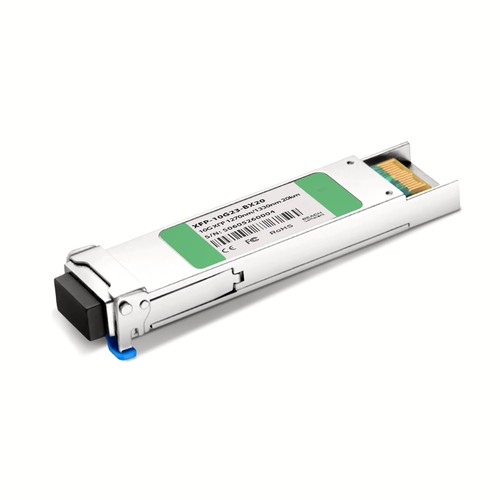
The XFP-10G-BX20U compatible module serves equipment requiring a 10G XFP interface with 1270nm-TX/1330nm-RX optics and a 20km rating. Connection is through LC simplex. Product data, application guidance and factory verification are presented together to support network teams verify host acceptance as well as physical interface fit.
OEM Part Number: XFP-10G-BX20UHT Part Number: XFP-10G23-BX20
Product Highlights
- Compatible alternative to Cisco XFP-10G-BX20U
- 10G connectivity at 10Gbps
- Optical wavelength: 1270nm-TX/1330nm-RX
- Specified reach: 20km
- LC simplex / SMF interface
- Operating temperature: 0 to 70°C (32 to 158°F)
- Factory compatibility verification and optical performance testing before shipment
Specifications
| Cisco Compatible | XFP-10G-BX20U |
|---|---|
| Manufacturer | HT |
| HT Part Number | XFP-10G23-BX20 |
| Form Factor | XFP |
| Max. Data Rate | 10Gbps |
| Wavelength | 1270nm-TX/1330nm-RX |
| Max. Transmission Distance | 20km |
| Connector | LC simplex |
| Transmitter Type | DFB BiDi |
| Media | SMF |
| DOM Support | YES |
| TX Power | -2~3dBm |
| Receiver Sensitivity | < -14dBm |
| Operating Temperature | 0 to 70°C (32 to 158°F) |
| Protocols | SFP+ MSA Compliant, CPRI, eCPRI |
Applications and Optical Link Design
This BiDi interface is useful where only one fiber strand is available between two sites or racks. It must be paired with the complementary wavelength direction: one end transmits on the wavelength that the other end receives. Verify the paired part number, connector polish and fiber plant before installation, and measure link loss against the specified optical budget.
Before deployment, check the host port type, supported data rate and firmware requirements. The 10G interface configuration must match the remote equipment; sharing a XFP housing alone does not make two transceiver types interoperable.
BiDi operation saves a fiber strand but makes wavelength orientation critical. Record the part installed at each end and check its paired receive wavelength. The 20km rating still depends on total channel loss, including connectors and splices.
Cisco Compatibility and Factory Testing
The module is checked for host recognition as XFP-10G-BX20U, link establishment and diagnostic reporting. Physical cage fit alone is not treated as evidence of compatibility. Equipment model, hardware revision and software release can be reviewed before dispatch where platform behavior is uncertain.
Optical Acceptance, Diagnostics and Handling
For this model, the specified transmit-power range is -2~3dBm; receiver sensitivity is < -14dBm. During commissioning, record the host diagnostic readings after the link has stabilized and compare them with those limits. DOM values are useful operational indicators, but they do not replace calibrated optical measurements when a link is marginal. Investigate unexpected loss through connector inspection, cleaning and a channel measurement before replacing the module. Before every insertion, keep dust caps in place until the patch lead is ready, avoid touching the optical end face and use an appropriate inspection and cleaning procedure. Do not look into an active optical interface.
Interoperability and Host Configuration
Check three layers before deployment: host acceptance of the module identity, port support for the stated rate, and a matching optical standard at the remote interface. For breakout operation, confirm lane configuration too. Similar-looking cages can behave differently across speeds and firmware settings. For this model, the principal parameters are data rate 10Gbps, wavelength 1270nm-TX/1330nm-RX, rated reach 20km.
Ordering Information
When ordering, specify XFP-10G-BX20U, XFP-10G23-BX20, quantity and intended host platform. Project labels can repeat these details for receiving and asset records. Neutral labels, customer packaging and project-specific compatibility review are available on request.
Shipping and Lead Time
Standard configurations normally ship within one to three working days, with production lead times confirmed for larger quantities. International courier, air freight and sea freight are available; customer courier accounts and nominated forwarders are accepted.
Quality Assurance and Packaging
Before packing, the module receives interface inspection, identification and link checks. Protective packaging avoids pressure on the connector and latch. Customer references, rack groups and project packing lists can be added for volume orders.
Frequently Asked Questions
Is this an original Cisco transceiver?
No. It is an HT-manufactured compatible alternative for equipment that specifies XFP-10G-BX20U, not an original Cisco-branded module.
Which fiber and connector are required?
Use LC simplex with SMF. The specified maximum reach is 20km, subject to fiber quality and total link loss.
Can it be mixed with another wavelength or reach version?
Only when the two ends share the same optical standard, wavelength plan and supported data rate. Check the exact part numbers and link budget rather than relying only on the module form factor.
Fiber Optic Cables
Fiber Transceivers
Get a quick quote
 Lisa Zhou
 Steve Yan
 Flora Luo
 Stone Wang
 Allen Hu
About us
China Factory:No 168 Golden Ground Industrial Area;Philippines Address:Makati City,Metro Manila, Philippines