SC APC Simplex Armored Fiber Patch Cable, OS2, Riser (OFCR)
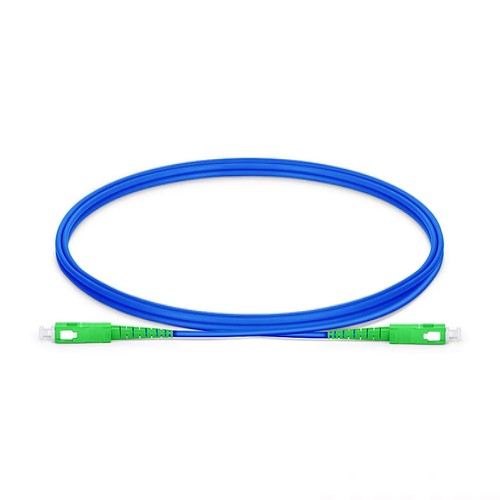
Projects in the Philippines benefit from keeping the configuration, branch identification and installation requirement consistent across every participating site. This simplex armored patch cable carries a single OS2 9/125µm fiber between two SC APC connectors, protected by a helical stainless steel tube under the blue 3.0mm riser-rated (OFCR) jacket. Whereas the steel armor guards the exposed last meters of the optical path, the angled APC polish holds return loss at 60dB or better, which is exactly what PON, CATV and other reflection-sensitive single-fiber systems demand.
Product Highlights
- G.657.A1 bend-insensitive fiber, 10/5D bend radius
- Riser (OFCR) flame rating for vertical building pathways
- Stock lengths 1m to 30m; custom lengths and jackets on request
- SC APC to SC APC simplex, OS2 9/125µm single mode
- Angled 8° polish for ≥60dB return loss
- Helical stainless steel armor against crush, impact and rodents
Specifications
| Connector Type | SC to SC |
|---|---|
| Polish Type | APC to APC |
| Fiber Mode | OS2 9/125µm |
| Wavelength | 1310/1550nm |
| Fiber Count | Simplex |
| Fiber Grade | G.657.A1 (Compatible with G.652.D) |
| Min. Bend Radius (Fiber Cable) | 10/5D (Dynamic/Static) |
| Cable Outside Diameter (OD) | 3.0mm |
| Flame Rating | Riser (OFCR) |
| Construction Type | Single Armored, Stainless Steel Tube |
| Tensile Strength | 120/225N (Long/Short Term) |
| Insertion Loss | ≤0.3dB |
| Return Loss | ≥60dB |
| Operating Temperature | -20 to 70°C (-4 to 158°F) |
| Storage Temperature | -40 to 70°C (-40 to 158°F) |
APC polish for reflection-sensitive systems
APC ferrules are ground at an 8-degree angle so that reflected light leaves the guided optical route instead of returning toward the source. In PON access networks, RF video overlay and DWDM links, that reflected power would otherwise destabilize lasers and corrupt the signal. The green SC housings identify the angled polish instantly, and the measured 60dB return loss is the figure those systems are engineered around.
Simplex cords for single-fiber transmission
A simplex cord carries one fiber and one direction of traffic, which matches BiDi transceivers, WDM systems, optical monitoring taps and test access points. Where a duplex cord would leave one fiber dark and coiled in the tray, the simplex build keeps the patching field cleaner and makes tracing a single strand straightforward. Project teams in the Philippines can carry this requirement into the site documentation used by each contractor.
Armored protection for access-network tails
The last meters of a FTTx or access optical path are typically the most exposed: wall outlets, cabinet doors, drop terminals and basement risers. A helical steel tube around the buffered fiber means these tails survive being stepped on, kinked behind furniture-grade enclosures or chewed in utility spaces, without the installer having to sleeve the run in conduit.
FTTx and PON applications
In PON plant this cord in typical deployments appears between the OLT or splitter cabinet and the first distribution point, and as the service tail at customer premises. The APC polish is what PON was standardized around; as a result, the cord drops into GPON, XGS-PON and NG-PON2 links without return-loss concerns. Where the plant uses LSZH jackets indoors, the LSZH configuration of the equivalent build keeps the jacket policy consistent end to end.
Length selection and customization
Standard size options are stocked for fast delivery: 1m (3ft), 2m (7ft), 3m (10ft), 5m (16ft), 10m (33ft), 15m (49ft), 20m (66ft) and 30m (98ft), covering the common rack-to-rack, access and frame connections this cord is built for. Non-standard lengths beyond this range are manufactured to order. In access networks the tail is typically cut into an existing plan; as a result, give the measured channel length and the cord arrives without surplus slack to store behind the ODF. Specifying the particular channel length avoids both the slack storage problem of an overlong cord and the strain risk of one that is too short.
Production testing and quality assurance
Each item is terminated with precision zirconia ferrule SC APC connectors and measured for insertion loss and return loss before packing; both the 0.3dB insertion ceiling and the 60dB return floor are verified per cord. Apex offset and fiber height are checked to keep the angled physical contact consistent over repeat matings.
Placing an Order and Factory Support
Quote against the SC APC simplex armored product line with the channel length and jacket rating stated. For other connector or polish combinations, including hybrid LC-to-SC builds, use the customized simplex armored program and the factory will validate the specification before release to production. Customers in the Philippines can include multi-site labeling or documentation requirements when requesting a project quotation.
Fiber Optic Cables
Fiber Transceivers
Get a quick quote
 Lisa Zhou
 Steve Yan
 Flora Luo
 Stone Wang
 Allen Hu
About us
China Factory:No 168 Golden Ground Industrial Area;Philippines Address:Makati City,Metro Manila, Philippines