SC UPC Simplex Armored Fiber Patch Cable, OS2, Riser (OFCR)
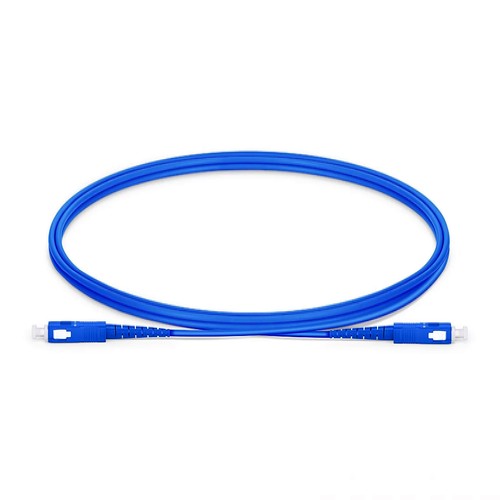
Projects in the Philippines benefit from keeping the configuration, branch identification and installation requirement consistent across every participating site. This simplex armored patch cable runs one OS2 9/125µm single-mode fiber between two SC UPC connectors, wrapped in a helical stainless steel tube under the blue 3.0mm riser-rated (OFCR) jacket. It suits the long tail of equipment that still speaks SC UPC: media converters, legacy ODFs, industrial switches and test sets that now sit at the exposed edge of the network. Project teams in the Philippines can carry this requirement into the site documentation used by each contractor.
Product Highlights
- Riser (OFCR) flame rating for vertical building pathways
- Insertion loss ≤0.3dB, return loss ≥50dB
- Stock lengths 1m to 30m; custom lengths and jackets on request
- SC UPC to SC UPC simplex, OS2 9/125µm single mode
- Helical stainless steel armor against crush, impact and rodents
- G.657.A1 bend-insensitive fiber, 10/5D bend radius
Specifications
| Connector Type | SC to SC |
|---|---|
| Polish Type | UPC to UPC |
| Fiber Mode | OS2 9/125µm |
| Wavelength | 1310/1550nm |
| Fiber Count | Simplex |
| Fiber Grade | G.657.A1 (Compatible with G.652.D) |
| Min. Bend Radius (Fiber Cable) | 10/5D (Dynamic/Static) |
| Cable Outside Diameter (OD) | 3.0mm |
| Flame Rating | Riser (OFCR) |
| Construction Type | Single Armored, Stainless Steel Tube |
| Tensile Strength | 120/225N (Long/Short Term) |
| Insertion Loss | ≤0.3dB |
| Return Loss | ≥50dB |
| Operating Temperature | -20 to 70°C (-4 to 158°F) |
| Storage Temperature | -40 to 70°C (-40 to 158°F) |
Simplex SC for BiDi optics and single-fiber links
Bidirectional transceivers put both directions on one strand, and a simplex SC cord is the natural patching format for them. The equivalent build serves WDM monitor ports, optical taps and any optical path where only one fiber is lit. Patching with a single-fiber cord keeps the unused side of the frame free and makes the strand easy to trace months later.
Where SC UPC remains the standard
Media converters, older carrier CPE, industrial Ethernet switches and much installed ODF hardware still present SC UPC ports. The push-pull SC body is tolerant of frequent handling and easy to clean and review, which keeps it in service long after LC took over the transceiver side. This cord lets that plant stay exactly as documented while gaining armored protection.
Armor under the floor and behind the wall
Simplex tails typically disappear into places nobody inspects again: beneath raised floors, behind wall boxes, along baseboards in retrofit offices. Those are precisely the routes where unarmored patch leads get crushed or chewed. The helical steel tube inside this cord carries the mechanical rating; as a result, the pathway needs no conduit and the optical path survives the life of the building.
Media converters and industrial links
A large share of simplex SC UPC demand comes from media converters and industrial Ethernet gear linking control rooms to field cabinets. These links run for years in cabinets that get opened monthly; as a result, the cord is handled far more than a data-center jumper. The armored build and the 1000-cycle ferrule rating are aimed at exactly that service pattern, and the stock lengths cover the usual cabinet-to-frame distances.
Length selection and customization
Standard size options are stocked for fast delivery: 1m (3ft), 2m (7ft), 3m (10ft), 5m (16ft), 10m (33ft), 15m (49ft), 20m (66ft) and 30m (98ft), covering the common rack-to-rack, access and frame connections this cord is built for. Non-standard lengths beyond this range are manufactured to order. Because simplex tails are frequently dressed into tight enclosures, ordering the measured length avoids the coil of slack that otherwise ends up trapped behind the fiber panel. Specifying the particular channel length avoids both the slack storage problem of an overlong cord and the strain risk of one that is too short.
Production testing and quality assurance
Every cord is terminated with precision zirconia ferrule SC connectors and verified for insertion loss and return loss before packing; the 0.3dB and 50dB figures are tested values on each item. End-face geometry is inspected for predictable physical contact, and the ferrules are rated for up to one thousand mating cycles.
Placing an Order and Factory Support
Refer to the SC UPC simplex armored product line when submitting a request for a quotation, stating the channel length and jacket rating. Other connector mixes and polish types, including hybrid builds, are handled through the customized simplex armored program once the factory confirms the specification. Customers in the Philippines can include multi-site labeling or documentation requirements when requesting a project quotation.
Fiber Optic Cables
Fiber Transceivers
Get a quick quote
 Lisa Zhou
 Steve Yan
 Flora Luo
 Stone Wang
 Allen Hu
About us
China Factory:No 168 Golden Ground Industrial Area;Philippines Address:Makati City,Metro Manila, Philippines